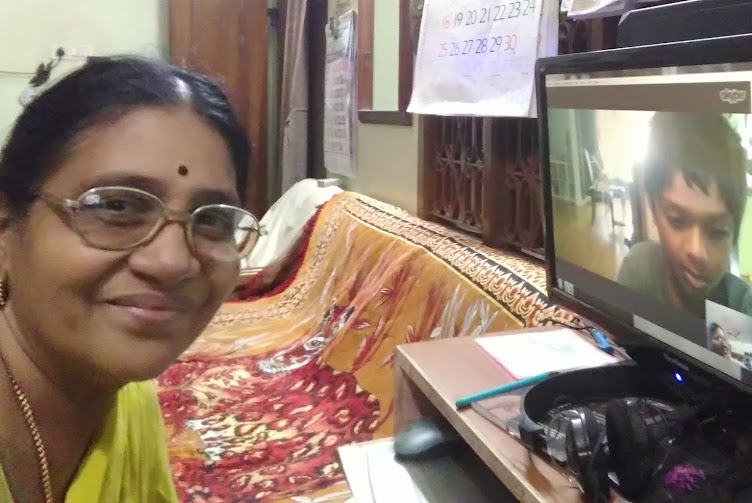
I teach Maths, English Grammar and Spoken English efficiently. My wish is to teach the children of all countries online. My classes will be interactive and interesting. I render assignment help and proof reading through e-mail learning and whatsapp learning. skype id: selviraveendran mail id : onlinetutorselviraveendran@gmail.com Whatsapp No: 9442624629
Popular Posts
-
 SENTENCE PATTERNS WITH EXAMPLES Subject (S) Verb (V) Object (O) Complement (C) Adverbial (A) Direct Object (DO) Indirect...
-
 Sentence Pattern - Exercise Identify the pattern of the following sentence : 1.She / will come a) SV b) SVO c) SVC d) SVO...
-
7 Basic Sentence Patterns The English language has seven basic sentence (or clause) patterns. Examples are: John / laughed. (SV)*...
-
 TYPES OF SENTENCES In writing and speaking, there are four basic types of sentences that we use for different purposes: declarati...
-
Sentence Pattern: What is sentence pattern? Systematic arrangement of words in a sentence meaningfully is sentence pattern...
-
 FINITE AND NON-FINITE VERBS Identify the finite and non-finite verbs in the following sentences. 1. My little brother wants to be ...
-
 PHRASES WORKSHEET Identify the phrases in the following sentences and state their kind 1. He was a man of great wealth. 2. Th...
-
English Grammar Worksheets Free PDF ebook Download from Larisa School of Language Nikolaev Ukraine over One Hundred Pages from Laris...


Thursday, July 9, 2015


Wednesday, July 8, 2015
PARTS OF SPEECH - A COMPLETE VIEW
PARTS OF SPEECH
Traditional grammar classifies words based on
eight parts of speech: the verb, the noun, the pronoun, the adjective, the adverb, the preposition, the conjunction, and the interjection.
Each part of speech explains not what the
word is, but how the word is used. In fact, the same word can be a noun in
one sentence and a verb or adjective in the next. The
next few examples show how a word's part of speech can change from one sentence
to the next, and following them is a series of sections on the individual parts
of speech, followed by an exercise.
Books are made of ink, paper, and glue.
Deborah waits
patiently while Bridget books the tickets.
Here
"books" is a verb, and its subject is "Bridget."
We walk down
the street.
In
this sentence, "walk" is a verb, and its subject is the pronoun
"we."
The mail carrier stood
on the walk.
In
this example, "walk" is a noun, which is part of a prepositional phrase describing where the
mail carrier stood.
The town decided to
build a new jail.
The sheriff told
us that if we did not leave town immediately he would jail us.
They heard high
pitched cries in the middle of the night.
The baby cries all
night long and all day long.
But here "cries" is a verb that describes the
actions of the subject of the sentence, the baby.
PARTS OF SPEECH -
TABLE
|
PART OF SPEECH
|
BASIC FUNCTION
|
EXAMPLES
|
|
Noun
|
names a
person, place, or a thing
|
Indian, Ooty,
ship
|
|
Pronoun
|
takes the
place of a noun
|
I, you, he,
she, it, ours, them, who
|
|
Verb
|
identifies
action or state of being
|
sing, dance,
believe, be
|
|
Adjective
|
modifies a
noun
|
hot, lazy,
funny, lucky
|
|
Adverb
|
modifies a
verb, adjective, or other adverb
|
softly,
lazily, often, very
|
|
Preposition
|
shows a
relationship between a noun (or pronoun) and other words in a sentence
|
up, over,
against, by, for
|
|
Conjunction
|
joins words,
phrases, and clauses
|
and, but, or,
yet, else
|
|
Interjection
|
expresses
emotion
|
Hurrah, ah,
whoops, ouch
|
ADDITIONAL REFERENCE
Monday, June 29, 2015
Subscribe to:
Posts (Atom)