


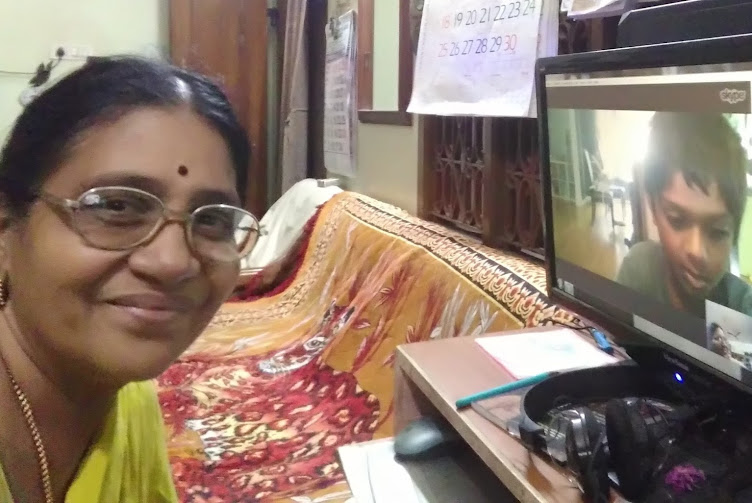
I teach Maths, English Grammar and Spoken English efficiently. My wish is to teach the children of all countries online. My classes will be interactive and interesting. I render assignment help and proof reading through e-mail learning and whatsapp learning. skype id: selviraveendran mail id : onlinetutorselviraveendran@gmail.com Whatsapp No: 9442624629
Popular Posts
-
 SENTENCE PATTERNS WITH EXAMPLES Subject (S) Verb (V) Object (O) Complement (C) Adverbial (A) Direct Object (DO) Indirect...
 -
 Sentence Pattern - Exercise Identify the pattern of the following sentence : 1.She / will come a) SV b) SVO c) SVC d) SVO...
 -
7 Basic Sentence Patterns The English language has seven basic sentence (or clause) patterns. Examples are: John / laughed. (SV)*...
-
Sentence Pattern: What is sentence pattern? Systematic arrangement of words in a sentence meaningfully is sentence pattern...
-
 TYPES OF SENTENCES In writing and speaking, there are four basic types of sentences that we use for different purposes: declarati...
 -
 FINITE AND NON-FINITE VERBS Identify the finite and non-finite verbs in the following sentences. 1. My little brother wants to be ...
 -
 PHRASES WORKSHEET Identify the phrases in the following sentences and state their kind 1. He was a man of great wealth. 2. Th...
 -
English Grammar Worksheets Free PDF ebook Download from Larisa School of Language Nikolaev Ukraine over One Hundred Pages from Laris...
Wednesday, March 20, 2013


Tuesday, March 5, 2013
Wednesday, January 9, 2013
Saturday, December 22, 2012
Thursday, December 20, 2012
Monday, December 10, 2012
Kinds of Adverbs
Kinds of Adverbs
Here you can see the basic kinds of adverbs.
Adverbs of Manner
Adverbs of Manner tell us the manner or way in which something happens. They answer the question "how?". Adverbs of Manner mainly modify verbs.
- He speaks slowly. (How does he speak?)
- They helped us cheerfully. (How did they help us?)
- James Bond drives his cars fast. (How does James Bond drive his cars?)
Adverbs of Place
Adverbs of Place tell us the place where something happens. They answer the question "where?". Adverbs of Place mainly modify verbs.
- Please sit here. (Where should I sit?)
- They looked everywhere. (Where did they look?)
- Two cars were parked outside. (Where were two cars parked?)
Adverbs of Time
Adverbs of Time tell us something about the time that something happens. Adverbs of Time mainly modify verbs.
They can answer the question "when?":
- He came yesterday. (When did he come?)
- I want it now. (When do I want it?)
Or they can answer the question "how often?":
- They deliver the newspaper daily. (How often do they deliver the newspaper?)
- We sometimes watch a movie. (How often do we watch a movie?)
Adverbs of Degree
Adverbs of Degree tell us the degree or extent to which something happens. They answer the question "how much?" or "to what degree?". Adverbs of Degree can modify verbs, adjectives and other adverbs.
- She entirely agrees with him. (How much does she agree with him?)
- Mary is very beautiful. (To what degree is Mary beautiful? How beautiful is Mary?)
- He drove quite dangerously. (To what degree did he drive dangerously? How dangerously did he drive?)
Sunday, November 4, 2012
Find this and other adjectives exercises in English Exercises .org
EXERCISE--DEGREES OF COMPARISON
Write the appropriate form of the adjective in the brackets
1. The town is just as (large) as my native one.
2. The road was (long) than we had expected.
3. The girl is very (intelligent).
4. As soon as they understood that the second book was (boring) than the first one, they changed their mind.
5. The shop is (far) than the school.
6. Ventspils is (far) town in Latvia I have been to.
7. Tim is (intelligent) than Pat.
8. The heat is less (harmful) than the cold.
9. This song is (beautiful) one in the world!
10. They are as (stubborn) as donkeys!
11. The weather today is (bad) than the weather yesterday but not as (bad) as it was four days ago.
12. The story was (exciting) one I have ever heard.
13. They were less (tired) than we.
14. George bought a (new) car than he could ever imagine.
15. The mark is a (good) than I expected.
16. They are very (upset) with the results.
17. She is (polite) than me.
18. The boy is (fast) runner of all.
19. It is as (pleasant) as a greeting card.
20.The movie was (interesting) than the book.
21. The price will be less (aggressive) than the previous time.
22.The nature is (important) than making profit.
23.The cake is just as (sweet) as the ice-cream.
24.Sometimes friends are (devoted) than relatives.
25.Planes are (convenient) means of travelling of all.
26.Some cars are (expensive) than others.
27.The jeans are very (dirty) in fact they are (dirty) than the trousers.
28.Acandle gives (little) than a lamp.
29.This blanket is (warm) than that blanket.
30.The dog is (angry) than its master.
Subscribe to:
Posts (Atom)