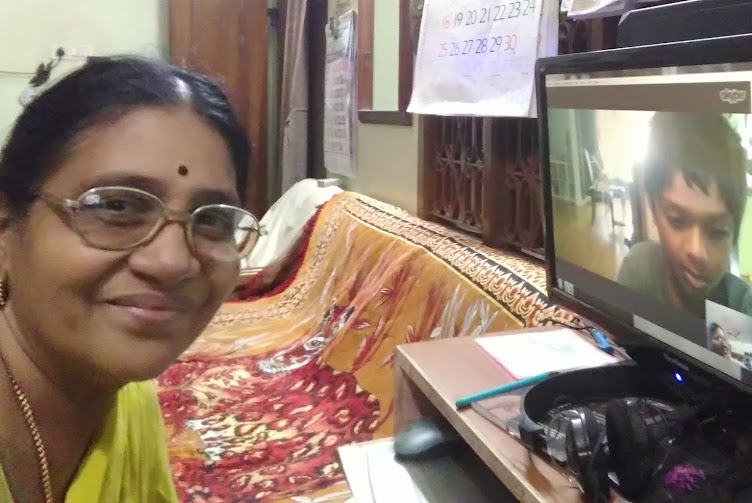
I teach Maths, English Grammar and Spoken English efficiently. My wish is to teach the children of all countries online. My classes will be interactive and interesting. I render assignment help and proof reading through e-mail learning and whatsapp learning. skype id: selviraveendran mail id : onlinetutorselviraveendran@gmail.com Whatsapp No: 9442624629
Popular Posts
-
 SENTENCE PATTERNS WITH EXAMPLES Subject (S) Verb (V) Object (O) Complement (C) Adverbial (A) Direct Object (DO) Indirect...
-
 Sentence Pattern - Exercise Identify the pattern of the following sentence : 1.She / will come a) SV b) SVO c) SVC d) SVO...
-
7 Basic Sentence Patterns The English language has seven basic sentence (or clause) patterns. Examples are: John / laughed. (SV)*...
-
 TYPES OF SENTENCES In writing and speaking, there are four basic types of sentences that we use for different purposes: declarati...
-
Sentence Pattern: What is sentence pattern? Systematic arrangement of words in a sentence meaningfully is sentence pattern...
-
 FINITE AND NON-FINITE VERBS Identify the finite and non-finite verbs in the following sentences. 1. My little brother wants to be ...
-
 PHRASES WORKSHEET Identify the phrases in the following sentences and state their kind 1. He was a man of great wealth. 2. Th...
-
English Grammar Worksheets Free PDF ebook Download from Larisa School of Language Nikolaev Ukraine over One Hundred Pages from Laris...


Monday, August 29, 2011


Saturday, February 19, 2011
evaluation reforms in B.Ed programme
EXAMINATION REFORMS IN B.ED. PROGRAMME
P.SELVI
SIVAKASI
ABSTRACT
Henry Steele opines” Change does not necessarily assure progress, but progress implcably requires change. Education is essential to change., for education creates both new wants and the ability to satisfy them”. In our country, 19th century education is imparted by 20th century teachers to 21st century students. In this way we are lagging behind by two centuries. Education should help the students to attain 21st century skills such as developing reasoning and thinking power, judgement and decision making ability, creativity, risk taking capacity, scientific temper, team spirit etc., Hence by developing the Inter-personal skills such as courtesy, giving respect, collaborative learning, communication skill, conflict resolution, empathy, tolerance and leadership qualities and the Intrapersonal skills such as problem solving, decision making, health habits, moral judgement, curiosity, imagination and thinking skills. How can the radical change take place? It can be put into practice by changing the curriculum and evaluation procedure of B.Ed programme. This paper suggests the following measures not only for teaching but also for evaluation.
- I advocate the principle of promoting the use of Technology to the maximum level.
- Teleconferencing should be made available to the students.
- EDUSAT should be utilized well.
- Numerous workshops and seminars should be organized to mobilize and encourage youth with the goal of envisioning sucessful future through education.
- I recommend conducting an annual conference to evaluate past progress and yet set higher goals that are realistic and attainable for students, mentors , teachers and parents.
Sunday, February 6, 2011
onlinelearning-a boon
21st century education has undergone a drastic change due to the technological improvements made.Normally in a class we come across quick performers, medium doers and late bloomers.Online learning provides optimum benefit for all type of learners.
The education system we have today was created in the 19th century to serve a different time with different needs. Educators borrowed the concept of uniformity and processed students in batches. The teachers could teach "the same subjects, in the same way, and at the same pace" to all students in the classroom.
Now that we ask more students to master higher-order knowledge and skills, this arrangement falls short. If the goal is to educate every student to the highest potential, the education system needs to be transformed from the present-day model where time is fixed and learning is variable into a student-centric model with a modular design that enables affordable mass customization so that time becomes the variable and learning can be the constant.
With education taking place online, students could learn "any time, any place, any path, any pace". Online education is not without pitfalls. Impersonal Communication, Time and Energy Drain, Technology, Learning Style, Financial Cost are some of the challenges faced by online learners. Since most communication take place via written messages, writing skills and the ability to put thoughts into words are paramount. Without this competence, the students experience significant frustration.
On the other hand online learning allows flexibility which is important for students with other commitments in pursuing university course work. Here we will analyse the promises, problems, and the future possibilities in online learning.
Subscribe to:
Posts (Atom)