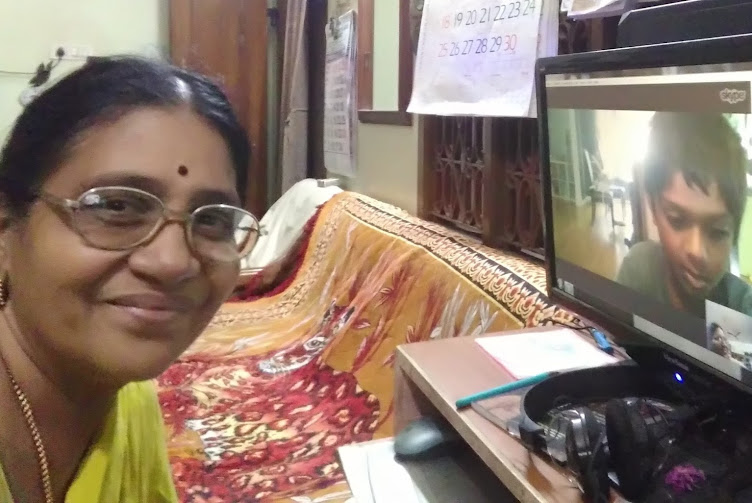
I teach Maths, English Grammar and Spoken English efficiently. My wish is to teach the children of all countries online. My classes will be interactive and interesting. I render assignment help and proof reading through e-mail learning and whatsapp learning. skype id: selviraveendran mail id : onlinetutorselviraveendran@gmail.com Whatsapp No: 9442624629
Popular Posts
-
 SENTENCE PATTERNS WITH EXAMPLES Subject (S) Verb (V) Object (O) Complement (C) Adverbial (A) Direct Object (DO) Indirect...
 -
 Sentence Pattern - Exercise Identify the pattern of the following sentence : 1.She / will come a) SV b) SVO c) SVC d) SVO...
 -
7 Basic Sentence Patterns The English language has seven basic sentence (or clause) patterns. Examples are: John / laughed. (SV)*...
-
Sentence Pattern: What is sentence pattern? Systematic arrangement of words in a sentence meaningfully is sentence pattern...
-
 TYPES OF SENTENCES In writing and speaking, there are four basic types of sentences that we use for different purposes: declarati...
 -
 FINITE AND NON-FINITE VERBS Identify the finite and non-finite verbs in the following sentences. 1. My little brother wants to be ...
 -
 PHRASES WORKSHEET Identify the phrases in the following sentences and state their kind 1. He was a man of great wealth. 2. Th...
 -
English Grammar Worksheets Free PDF ebook Download from Larisa School of Language Nikolaev Ukraine over One Hundred Pages from Laris...


Saturday, October 22, 2016


CHANGE INTO PASSIVE

CHANGE INTO PASSIVE
1. He has bought a fiat car.
2. I put down the pen.
3. I saw a hut at a distance.
4. All of them welcomed the suggestion enthusiastically.
5. Most of my friends have watched this movie.
6. The teacher appreciated the boy’s work.
7. Somebody has stolen the bicycle.
8. The police finally caught the notorious thief.
9. The head of the organization will run the project.
10. Firemen miraculously saved the people living on the second and third floors.
11. I am drafting a document now.
12. She will have sent the report.
Answers
1. A fiat car was bought by him.
2. The pen was put down by me.
3. A hut was seen (by me) at a distance.
4. The suggestion was enthusiastically welcomed by them all.
5. This movie has been watched by most of my friends.
6. The boy’s work was appreciated by the teacher.
7. The bicycle has been stolen.
8. The notorious thief was finally caught by the police.
9. The project will be run by the head of the organization.
10. The people living on the second and third floors were miraculously rescued by the firemen.
11. A document is being drafted by me.
12. The report will have been sent by her.
Monday, October 3, 2016
CHANGE INTO SIMPLE PAST

CHANGE INTO SIMPLE PAST
Sentences
are given in the simple present tense. Change them into the simple past tense.
1.
I drink coffee in the morning.
2.
She works at a bank.
3.
My father runs a small grocery store.
4.
My sister lives abroad.
5.
She earns a living by writing stories.
6.
He wants to be an engineer.
7.
Mother cooks delicious pasta every Sunday.
8.
The boys work hard to pass the test.
9.
She wants to leave.
10.
I don’t know the answer.
11.
Do you want to go?
12.
We do not believe in chauvinism.
13.
He is a fanatic.
14.
She writes short stories.
15.
The girl looks upset.
Answers
1.
I drank coffee in the morning.
2.
She worked at a bank.
3.
My father ran a small grocery store.
4.
My sister lived abroad.
5.
She earned a living by writing stories.
6.
He wanted to be an engineer.
7.
Mother cooked delicious pasta every Sunday.
8.
The boys worked hard to pass the test.
9.
She wanted to leave.
10.
I didn’t know the answer.
11. Did you want to go?
12.
We did not believe in chauvinism.
13.
He was a fanatic.
14.
She wrote short stories.
15.
The girl looked upset.
Sunday, October 2, 2016
Friday, September 30, 2016
CHANGE INTO PAST CONTINUOUS TENSE

CHANGE INTO PAST CONTINUOUS TENSE
We make the present continuous tense
form by putting is, am or are before the –ing form of the verb.
We make the past continuous tense form
by putting was or were before the –ing form of the verb.
Sentences are given in the present
continuous tense. Change them into the past continuous tense.
1. I am writing a letter.
2. What are you doing there?
3. Why are you crying?
4. He is preparing for the test.
5. You are disturbing me.
6. The dog is barking.
7. The girls are learning the poem.
8. Sania and Rohan are playing with
their ball.
9. Mother is watering the plants.
10. Father is fixing the stereo.
11. The girl is looking for her mother.
12. The birds are chirping.
13. The teacher is writing something on
the board.
14. The wind is blowing.
Answers
1. I was writing a
letter.
2. What were you doing
there?
3. Why were you
crying?
4. He was preparing
for the test.
5. You were disturbing
me.
6. The dog was barking.
7. The girls were learning
the poem.
8. Sania and Rohan were playing
with their ball.
9. Mother was watering
the plants.
10. Father was fixing
the stereo.
11. The girl was looking
for her mother.
12. The birds were chirping.
13. The teacher was writing
something on the board.
14. The wind was blowing.
Thursday, September 29, 2016
HAS OR HAVE

HAS OR HAVE
Use
has when the subject is a singular noun or singular pronoun.
Use
have when the subject is a plural noun or plural pronoun.
The
first person singular pronoun ‘I’ also take have.
Complete
the following sentences using has or have
1.
My parents ……………….. got an old Rolls Royce.
2.
She ……………… got two daughters.
3.
You ………………. no right to criticize me.
4.
Alice ……………… nothing to do with this.
5.
…………….. you invited them to your party?
6.
Ruth does not ……………. a job.
7.
Where ……………. he gone?
8.
You should not …………….. done this.
9.
How long …………….. you been waiting here?
10.
We ……………. no interest in this proposal.
11.
Mark ……………. not got a girlfriend.
12.
You should …………….. been more careful.
13.
It ……………. been raining since yesterday.
Answers
1.
My parents have got an old Rolls Royce.
2.
She has got two daughters.
3.
You have no right to criticize me.
4.
Alice has nothing to do with this.
5. Have you
invited them to your party?
6.
Ruth does not have a job.
7.
Where has he gone?
8.
You should not have done this.
9.
How long have you been waiting here?
10.
We have no interest in this proposal.
11.
Mark has not got a girlfriend.
12.
You should have been more careful.
13.
It has been raining since yesterday.
Monday, September 26, 2016
Wednesday, September 21, 2016
CONFUSING WORDS

CONFUSING WORDS
There
are some words which can cause confusion if we are not careful about their
spelling because they can be mistaken for another word which is very similar in
spelling.
Complete
the following sentences.
1.
The plants are ………………… They need more water and sunlight. (die / dye)
2.
The floor has a rough surface which makes …………………… very difficult. (mop / mope)
3.
I was ………………… that I would win the first prize. (hope / hop)
4.
It took me several days to ………………. out the paint on the walls. (scrap / scrape)
5.
The bird …………………. from branch to branch (hoped / hopped)
6.
The lie detection test was used to find out whether the witness had ……………….. in
his statement. (lied / lain)
7.
He was ………………… mad when he heard that his son had failed the test. (hoping /
hopping)
Answers
1.
The plants are dying. They need more water and sunlight.
2.
The floor has a rough surface which makes mopping very
difficult.
3.
I was hoping that I would win the first prize.
4.
It took me several days to scrape out the paint on the walls.
5.
The bird hopped from branch to branch.
6.
The lie detection test was used to find out whether the witness had lied in
his statement.
7.
He was hopping mad when he heard that his son had failed the
test.
Saturday, September 17, 2016
Subscribe to:
Posts (Atom)