
I teach Maths, English Grammar and Spoken English efficiently. My wish is to teach the children of all countries online. My classes will be interactive and interesting. I render assignment help and proof reading through e-mail learning and whatsapp learning. skype id: selviraveendran mail id : onlinetutorselviraveendran@gmail.com Whatsapp No: 9442624629
Popular Posts
-
 SENTENCE PATTERNS WITH EXAMPLES Subject (S) Verb (V) Object (O) Complement (C) Adverbial (A) Direct Object (DO) Indirect...
-
 Sentence Pattern - Exercise Identify the pattern of the following sentence : 1.She / will come a) SV b) SVO c) SVC d) SVO...
-
7 Basic Sentence Patterns The English language has seven basic sentence (or clause) patterns. Examples are: John / laughed. (SV)*...
-
 TYPES OF SENTENCES In writing and speaking, there are four basic types of sentences that we use for different purposes: declarati...
-
Sentence Pattern: What is sentence pattern? Systematic arrangement of words in a sentence meaningfully is sentence pattern...
-
 FINITE AND NON-FINITE VERBS Identify the finite and non-finite verbs in the following sentences. 1. My little brother wants to be ...
-
 PHRASES WORKSHEET Identify the phrases in the following sentences and state their kind 1. He was a man of great wealth. 2. Th...
-
English Grammar Worksheets Free PDF ebook Download from Larisa School of Language Nikolaev Ukraine over One Hundred Pages from Laris...


Tuesday, March 1, 2016


Wednesday, February 24, 2016
Monday, February 22, 2016
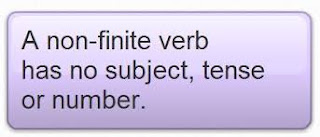
NON-FINITES EXERCISE
NON-FINITES EXERCISE


1. Having learnt his lesson, he went out to play cricket.
2. Walking along the street one day, I saw a dead cobra.
3. Leaving the forest we advanced into the open plain.
4. Driven out of his country, he sought asylum in a foreign land.
5. It being a very hot day, I remained in my tent.
6. A gipsy, wandering across the meadows, found the child.
7. I once saw a man walking on a rope.
8. Not knowing my way, I asked a policeman.
9. Hearing the noise, I woke up.
10. Being paralytic, he could not walk.
Answers
1. After he learnt his lesson, he went out to play cricket.
2. While I was walking along the street one day, I saw a dead cobra.
3. We left the forest and advanced into the open plain.
4. As he was driven out of his country, he sought asylum in a foreign land.
5. As it was a very hot day, I remained in my tent.
6. A gipsy found the child while he was wandering across the meadows.
7. I once saw a man who was walking on a rope.
8. As I did not know my way, I asked a policeman.
9. When I heard the noise, I woke up.
10. As he was paralytic, he could not walk.
Saturday, February 20, 2016


DIFFERENTIATION OF EXPONENTIAL FUNCTIONS

DERIVATIVE OF THE EXPONENTIAL FUNCTION
The derivative of ex is quite
remarkable. The expression for the derivative is the same as the expression
that we started with; that is, ex!
It means
the slope is the same as the function value (the y-value) for all points on the
graph.
Example: Let's
take the example when x = 2. At this point, the y-value is e2 ≈ 7.39.Since the derivative of ex is ex, then the slope of the tangent line at x = 2 is also e2 ≈ 7.39.
We can see that it is true on the graph:
Let's now see if it is true at some other values of x.
We can see that at x = 4, the y-value is 54.6 and the slope of the tangent (in red) is also 54.6.
At x = 5, the y-value is 148.4, as is the value of the derivative and the slope of the tangent (in green).
DIFFERENTIATION OF EXPONENTIAL FUNCTIONS
|
Solve the following problem
Differentiate y=e^(ax+b)
where a and b are constants
Let u = ax + b and y = e ^u
Use the chain rule to
find the derivative of function as follows
dy/dx = (dy / du) (du /
dx)
dy / du = e ^u and du / dx = a ( Since the derivative
of the constant b is 0)
Hence dy/dx = (e ^u)(a) = a e ^u
Hence dy/dx = (e ^u)(a) = a e ^u
Substitute u = ax + b in dy/dx above
dy/dx = a e ^ax + b
dy/dx = a e ^ax + b
VOLUME OF A TRIANGULAR PRISM

www.VirtualNerd.com

How Do You Find the Volume of a Triangular Prism?
Find the volume of the triangular prism below
SUMMARY
- B stands for the area of the base
- Since our bases are triangles, we can use (1/2)bh for B
- We can call the height of the triangle h1 and the height of the prism h2 to avoid confusion
- Volume is measured in units cubed, so we have 50 cm3

NOTES
- The volume of a prism is V=Bh
- B is the area of the base of the prism
- h is the height of the prism
- The base of our prism is a triangle, so we can use (1/2)bh, the area of a triangle, for B
- We can call the height of the triangle h1 and the height of the prism h2 to avoid confusion
- V is the volume, which is what we are trying to find
- b is the base of the triangle, which is 5 cm
- h1 is the height of the triangle, which is 2 cm
- h2 is the height of the prism, which is 10 cm
- We can plug 5 in for 'b', 2 in for 'h1', and 10 in for 'h2' in our equation
- We need to use the order of operations to simplify the right hand side
- First multiply 5•2 in the innermost parentheses
- Then multiply (1/2)•10 within the next set of parentheses
- This is the same as 10/2, or 5
- Then multiply 5•10 to get 50 cm3


Friday, February 19, 2016
MATHS IS BETTER IN COLOUR

Maths is better in colour. Level Up your skills with this channel. -->https://t.co/B5AD6XVjcO #maths #tutor pic.twitter.com/QaIBog1w4z
— Maths From Scratch (@MathsfrmScratch) February 16, 2016
Monday, February 15, 2016
INTRANSITIVE VERBS AS TRANSITIVE VERBS

INTRANSITIVE VERBS AS TRANSITIVE VERBS
When an
intransitive verb is used in a causative sense, it becomes transitive.
Study the
examples given below.
The horse walks.
(Intransitive)
The man walks the
horse. (Transitive – here the man causes the horse to walk.)
Birds fly.
(Intransitive)
The boys fly their
kites. (Transitive)
The
spellings of certain common verbs indicate whether they are transitive or
intransitive.
Many trees fell in
the storm. (Intransitive)
Woodcutters felled the
trees. (Transitive)
Lie still.
(Intransitive)
Lay the
basket on the table. (Transitive)
Rise early
with the lark. (Intransitive)
Raise your
hands. (= Cause your hands to rise.)
Sit here.
Set the
lamp on the table.
Some
intransitive verbs become transitive when a preposition is added to them.
His friends laughed
at him. (Laugh is an intransitive verb and does not take any object.
Laugh at is a transitive verb and takes the object ‘him’.)
He soon ran
through his fortune. (The verb run is intransitive whereas run through
is transitive. To run through one’s fortune is to use it rapidly.)
Please look
into the matter carefully.
I wish
for nothing.
Sometimes
the preposition is prefixed to the verb.
He overcame his
enemy. (Come is an intransitive verb, but overcome is transitive.)
He bravely withstood the
attack. (Stand is an intransitive verb, but withstand is transitive.)
Thursday, February 11, 2016
PAST CONTINUOUS TENSE WORKSHEET
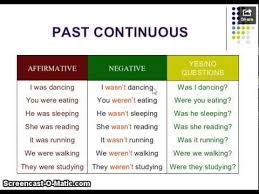
PAST CONTINUOUS TENSE WORKSHEET
MAKE SENTENCES IN THE PAST
CONTINUOUS TENSE USING THE VERB GIVEN IN THE BRACKETS.
Subscribe to:
Posts (Atom)